
Biomass Boilers
Biomass Heating Systems
Biomass heating systems come in many forms, burning logs, pellets, wood chips or even waste wood. Modern biomass boilers are highly efficient and environmentally responsible, producing very low emissions while using a naturally carbon‑neutral fuel source.
Biomass boilers are available in a wide range of outputs, starting from around 7 kW and scaling up to large commercial and industrial units. This makes them suitable for almost any type of property—from single domestic homes to large rural estates, offices, workshops and industrial buildings. It is also common to heat multiple properties from a single boiler using district_heating, a simple and effective way to distribute renewable heat.
Gondwana Green Heat has more than twenty years of experience in biomass systems and was one of only five companies offering biomass heating in Scotland before government grant schemes entered the market. Our long‑term involvement means we understand the technology, the installation requirements and the practical realities of running biomass systems in Scottish homes and businesses.
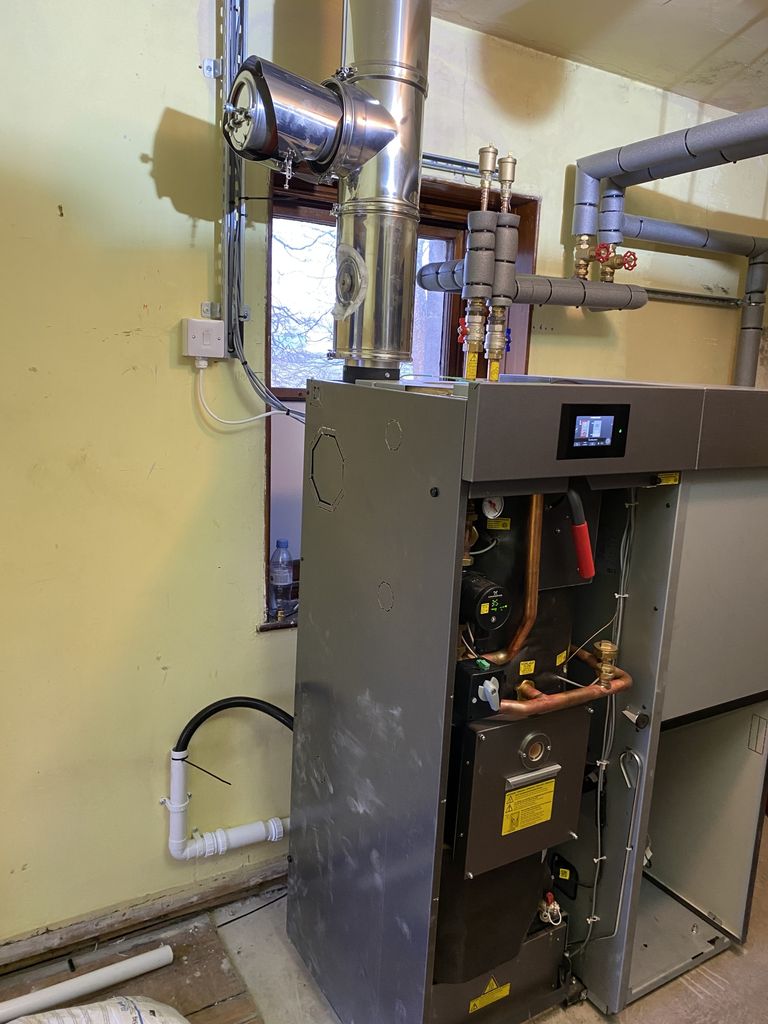
Types of Biomass boilers we can offer.
1. Log boilers
Log Boilers (Batch Boilers)
Log_boilers—also known as batch boilers—are gasification biomass boilers designed to burn wood logs or briquettes and charge a large accumulator tank of water. The stored heat can then be used for industrial processes, space heating or domestic hot water.
Log boilers are often chosen by customers who have access to free or low‑cost firewood. They do, however, require some user involvement: typically lighting a fire once or twice a day in winter, and once every 4–7 days in summer, depending on demand and tank size.
Gondwana Green Heat supplies log gasification boilers from 10 kW to 100 kW, and larger outputs can be achieved by installing multiple boilers in parallel. This makes them suitable for everything from single homes to workshops, estates and small commercial applications.
Log boilers remain one of the most efficient and cost‑effective ways to convert wood fuel into usable heat, especially when paired with a correctly sized thermal store.
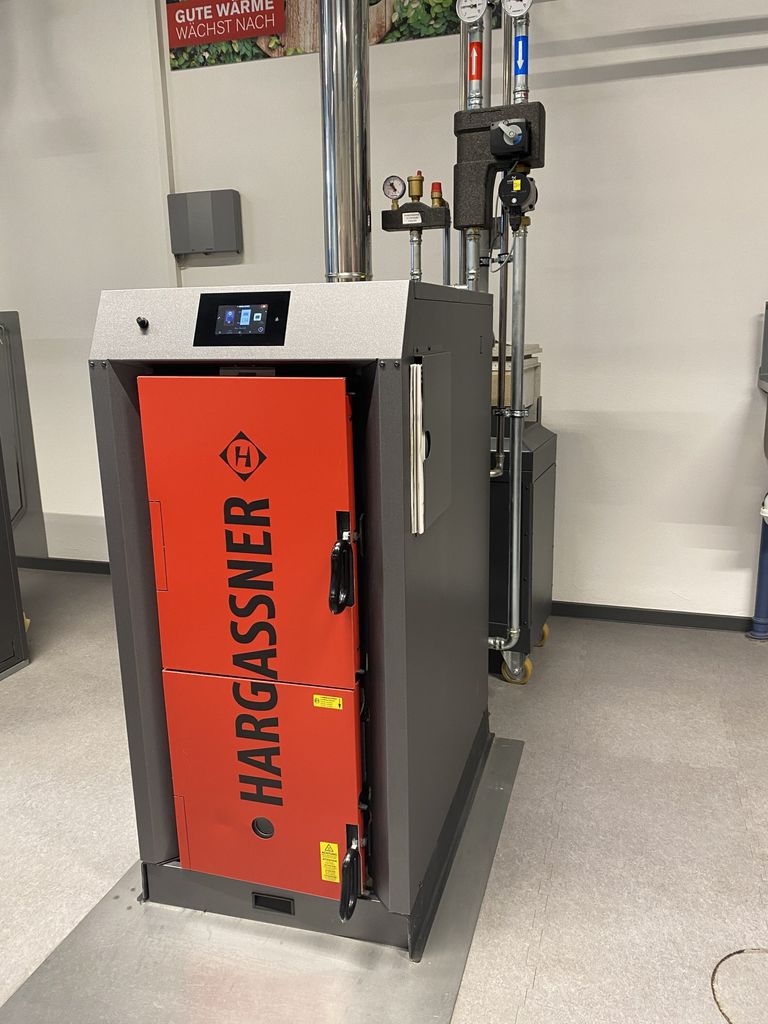
2. Pellet Boilers
Pellet Boilers
Most people are now familiar with wood_pellets as a fuel. Pellets are simply compressed sawdust, dried to a very low moisture content and supplied either in 10 kg bags or delivered in bulk by tanker and “blown in” to a storage silo. Bulk pellets are typically the most economical option, usually around £300–£350 per 1,000 kg. It is essential to use pellets that meet the correct boiler specification—poor‑quality pellets increase breakdown risk and deliver lower energy value.
Pellet boilers operate differently from log_gasification_boilers. They are fully automated: they ignite, modulate and shut down without user involvement. Most models include a built‑in hopper, while larger systems use external silos or storage rooms that feed pellets automatically into the boiler. The main advantage of pellet systems is their convenience—they behave much like modern oil or gas boilers in day‑to‑day operation.
Gondwana Green Heat installs pellet boilers from 7 kW upwards, with no upper limit. This makes pellet systems suitable for domestic homes, commercial buildings, workshops, estates and district‑heating applications.
Why We Install Hargassner Biomass Boilers
At Gondwana, we currently install only Hargassner biomass boilers. The reason is simple: their engineering quality is unmatched.
Hargassner boilers use a ceramic combustion core, which significantly reduces emissions by maintaining extremely high combustion temperatures. This super‑heated ceramic chamber burns off more particulates, improves efficiency and makes ignition of pellets, chips and other fuels cleaner and more reliable.
Hargassner also manufactures a complete range of in‑house fuel‑delivery systems for pellet and chip boilers—augers, suction systems, agitators and silo solutions—ensuring long‑term reliability and correct fuel handling.
Another advantage is Hargassner’s biomass link‑up capability, allowing a log boiler and pellet boiler to be connected into one system. This gives you the best of both worlds:
- free or low‑cost log fuel when available
- fully automated pellet heating when convenience is required
3. Wood Chip Biomass Boilers
Wood Chip Biomass Boilers
Wood_chip_biomass_boilers burn chipped waste wood that has been processed through a chipper to create a consistent fuel. Wood chip systems are typically used in larger commercial, industrial or district_heating applications due to the higher capital cost and the scale required to make them economical. For estates, farms, forestry operations or businesses with their own supply of wood chip, they can be extremely cost‑effective to run.
All of our chip boilers feature automated ignition and fire up on demand, operating in a similar way to pellet_boilers. Like pellet systems, wood chips are stored in a dedicated fuel store and delivered to the boiler via an automated feed system—augers, agitators or suction systems depending on the installation.
Wood chip boilers offer a robust, renewable and scalable heating solution for sites with high heat demand and access to suitable fuel. When paired with a correctly designed thermal_store and distribution system, they provide reliable, low‑emission heating for large buildings or multiple properties.
4. Log / Waste Wood Forced Air Biomass
Forced‑Air Biomass Heaters
Forced_air_biomass_heaters operate on a simple but highly effective principle: imagine a drum within a drum. A fire is lit in the inner drum, and the space between the two drums becomes a high‑temperature air chamber. This hot air is then blown through ducting to heat the building. There are no radiators, no hot‑water circuits, and no thermal stores—just direct, high‑volume warm air.
The main advantages of forced‑air biomass systems are:
- Low capital cost compared with other biomass technologies
- Rapid heat‑up times, ideal for cold industrial spaces
- Simple, robust operation with minimal system complexity
These heaters are designed specifically for commercial spaces, industrial units and workshops, where fast, direct air heating is more practical than water‑based systems.
Gondwana Green Heat has installed many of these systems in joinery workshops, sawmills, and other timber‑industry environments where large open spaces need quick, reliable heating and where waste wood is readily available as fuel.
Forced‑air biomass heaters provide a durable, low‑emission solution for sites where conventional radiator or underfloor systems are not suitable.
Biomass Boilers — A Direct Replacement for Oil and Gas
Biomass_boilers are an excellent replacement for oil and gas systems, with no need to change existing heat emitters. They can heat anything from small rural homes to large commercial buildings, and the wide range of boiler sizes means there is a biomass solution for almost every property.
Biomass systems are particularly popular in rural areas where mains gas is unavailable, oil prices fluctuate, and direct electric heating is prohibitively expensive. With outputs starting around 7 kW and scaling to industrial levels, biomass boilers offer a stable, renewable and cost‑effective heating option.
District Heating
Gondwana Green Heat is heavily involved in district_heating, where multiple homes, apartments or commercial buildings are supplied from a single biomass boiler. This approach can:
- reduce initial installation costs
- simplify servicing and maintenance
- improve overall system efficiency
- centralise fuel handling and storage
District heating is a strong option for estates, rural developments, farms, commercial yards and multi‑unit properties.
Hot‑Water Storage Systems
As well as installing biomass boilers, Gondwana supplies and fits a full range of thermal stores and hot‑water storage systems. These tanks are integral to the correct operation of many biomass systems, ensuring stable heat delivery, efficient boiler cycling and reliable hot‑water performance.
Please see our relevant pages for more information on storage options and system design.


